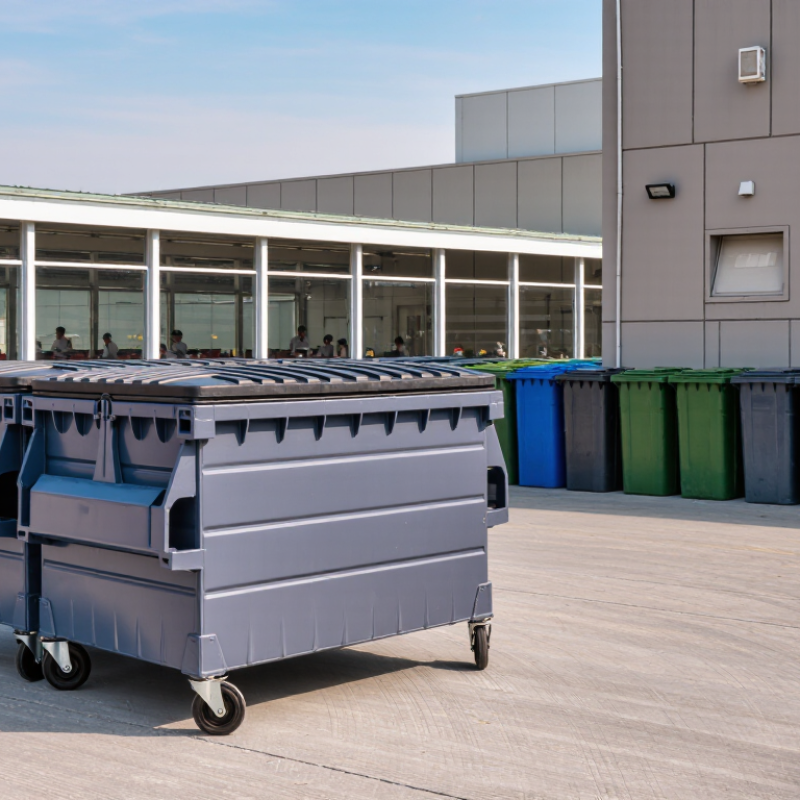
Choosing a Trash Can MANUFACTURER in 2026 requires more than comparing prices, colors, or catalog photos. Waste systems are under pressure. The United Nations Environment Programme’s Global Waste Management Outlook 2024 projects municipal solid waste will rise from about 2.3 billion tonnes in 2023 to nearly 3.8 billion tonnes by 2050. Every container will face heavier use.
Small details matter.
The World Bank’s What a Waste 2.0 report estimates that the world generated 2.01 billion tonnes of municipal solid waste in 2016. It also warns that waste could reach 3.40 billion tonnes by 2050 without major improvements. These figures make material strength, capacity planning, collection efficiency, and repair support practical purchasing issues. A thin lid may fail beside a busy food court. A poorly sealed body may create odors beside a hotel kitchen. A weak wheel can stop an entire route.
Silpa Kaza, lead author of the World Bank report, stated, “Without good data, it is difficult to make good decisions.” Her point applies directly to supplier selection. Ask manufacturers for test methods, recycled-content evidence, load ratings, warranty terms, and production records. Check whether their claims match real samples. ISO 9001 certification can support quality controls, but it does not guarantee every product will perform well. That is where buyers must remain cautious. No checklist is perfect. The best Trash Can MANUFACTURER should combine reliable engineering, transparent documentation, responsive service, and proven experience in your operating environment.
Before choosing a trash can manufacturer in 2026, define what the product must achieve. Start with capacity, placement, user traffic, and emptying frequency. A 30-liter bin may suit a small office, while a busy food area may need 120 liters or more. Measure the available space carefully. Doorways and service lifts can create unexpected problems.
Consider material, hygiene, durability, and appearance. Stainless steel offers a clean look, but coated steel may reduce costs. Plastic can be lighter and easier to move. Decide whether you need lids, liners, wheels, ash compartments, or separate waste sections. Also set purchasing goals, such as a target price, delivery schedule, replacement plan, and expected service life. A low quote is not always economical. I once overlooked lid maintenance, and the installation became more expensive than planned.
Tips:Create a simple requirement sheet before contacting manufacturers. Include dimensions, capacity, material, color, quantity, delivery location, and inspection standards. Ask for production samples, material details, warranty terms, and quality-control records. Check whether the manufacturer can repeat the same specifications across future orders. Small changes in steel thickness or hinge design can affect daily use. Leave room for review. Your first specification may be too ambitious, or it may miss an important cleaning detail. A practical trial order can reveal noise, stability, and emptying issues before full production.
How to Choose a Trash Can Manufacturer in 2026?
Demand is rising. The United Nations Environment Programme reports that municipal solid waste may increase from 2.3 billion tonnes in 2023 to 3.8 billion tonnes by 2050. This pressure makes material selection more important than appearance alone. Stainless steel suits high-traffic interiors because it resists corrosion and repeated cleaning. Galvanized steel can offer strength at a lower cost. Recycled HDPE works well for lightweight outdoor containers, but sunlight exposure and temperature changes require testing.
Design should match the place of use. A narrow, pedal-operated bin may suit a small kitchen. A larger unit needs stable wheels, reinforced hinges, and a lid that closes quietly. Touchless systems can improve hygiene, yet sensors may fail in dusty or crowded environments. I would request samples before approving a large order. Photographs rarely reveal weak welds or awkward liner removal. Small details matter.
Product capability separates a catalog seller from a reliable manufacturer. Check tooling control, batch inspection, load testing, surface-finish standards, and replacement-part support. ISO 9001 certification can indicate documented quality processes, although certification does not guarantee every shipment. UNEP’s Global Waste Management Outlook 2024 also highlights the growing cost of waste collection and treatment, so inefficient designs can create long-term operating expenses. Ask for material certificates, test records, packaging specifications, and realistic lead times. Be cautious with perfect promises. Production data is more useful.
This benchmark compares commonly used trash-can materials against practical procurement criteria. Galvanized steel and stainless steel generally provide strong rigidity and fire resistance, while HDPE offers lower weight and excellent impact resistance. Aluminum is lightweight and corrosion resistant, but manufacturers should be checked for forming, welding, coating, and customization capabilities.
When choosing a trash can manufacturer in 2026, inspect quality systems before comparing prices. The World Bank projects global waste generation could reach 3.40 billion tonnes annually by 2050. That pressure makes durable containers more important. Ask whether the factory operates under ISO 9001 for quality management. ISO 14001 can also indicate structured environmental controls. However, certificates are useful, not magical. Check the certificate scope, issuing body, and renewal date.
Production evidence matters more than polished brochures. Request material specifications, batch records, and inspection reports for each model. A reliable factory should test load capacity, lid hinges, wheel strength, and odor-resistant surfaces. For outdoor units, ask about corrosion testing, drainage design, and ultraviolet exposure. EN 840 testing may support mobile waste containers, but the exact standard must match the product. During a factory visit, inspect sheet thickness with a gauge and observe random sampling. Small details reveal process discipline.
Tips: Ask for three recent production samples. Compare their dimensions, welds, edges, and lid alignment. Review corrective-action records, not only pass certificates. The UNEP Global Waste Management Outlook 2024 estimates municipal solid waste could rise from about 2.1 billion tonnes in 2023 to 3.8 billion tonnes by 2050. Manufacturers should therefore show scalable capacity without sacrificing inspection control. One weakness remains: many buyers trust documentation too quickly. Add independent pre-shipment checks, even when the supplier appears experienced.
| Evaluation Dimension | Verified Fact or Standard | Evidence to Request | Practical Evaluation Benchmark | Risk Indicator |
|---|---|---|---|---|
| Quality Management | ISO 9001 specifies requirements for a quality management system. It does not certify that every individual product is defect-free. | Valid certificate, certification scope, issuing certification body, audit status, documented inspection procedures, and corrective-action records. | The certificate covers the relevant manufacturing site and product activity; inspection records are traceable to production batches. | Certificate is expired, covers another site, or cannot be independently verified. |
| Environmental Management | ISO 14001 addresses environmental management systems, including compliance obligations, environmental impacts, and continual improvement. | ISO 14001 certificate, environmental objectives, waste-handling records, material-recycling procedures, and applicable permits. | The manufacturer measures process waste and identifies recycled-content claims by material type and percentage. | Unsubstantiated “eco-friendly” claims or no documentation for recycled content. |
| Occupational Health and Safety | ISO 45001 provides requirements for an occupational health and safety management system; it is separate from product safety certification. | Certificate, workplace risk assessments, incident statistics, training records, and machine-safety procedures. | The certificate applies to the actual production facility and the manufacturer can explain controls for molding, stamping, welding, and material handling. | Safety certification applies only to an office or unrelated facility. |
| Applicable Product Standards | EN 840 is a European standard series for mobile waste and recycling containers, including dimensions, performance, and test methods for applicable container types. | Test reports identifying the exact model, capacity, configuration, test method, laboratory, and test date. | The test report matches the proposed lid, wheels, body, lifting features, and nominal capacity rather than a different model. | A general “CE” or “international standard” statement is provided without a model-specific report. |
| Material Specification | High-density polyethylene is commonly used for impact-resistant molded containers; stainless-steel products should identify the grade, such as 304 or 316, when applicable. | Material datasheets, certificates of analysis, resin or metal grade, UV-stabilizer details, thickness drawings, and incoming-material inspection records. | Material grade and wall thickness are defined on controlled drawings, and incoming materials can be traced to supplier batches. | The supplier gives only a generic description such as “premium plastic” or “stainless metal.” |
| Manufacturing Process Control | Injection molding, rotational molding, sheet-metal forming, welding, coating, and assembly each require different process controls and inspection points. | Process flow chart, control plan, equipment list, preventive-maintenance schedule, first-article approval, and in-process inspection records. | Critical dimensions, lid fit, wheel alignment, weld quality, coating thickness, and moving-part function are checked at defined stages. | No controlled drawings, undocumented subcontracting, or only final visual inspection. |
| Durability and Functional Testing | Relevant tests may include impact resistance, static loading, wheel or caster performance, lid operation, corrosion resistance, and weathering, depending on product type and application. | Test plan, acceptance criteria, laboratory reports, sample identification, conditioning details, and failure records. | Tests represent the intended operating environment, including outdoor exposure, repeated movement, liquid contact, and the specified load condition. | Only photographs or short demonstration videos are offered as durability evidence. |
| Traceability and Batch Control | Traceability links raw materials, production records, inspections, and shipment information to a defined batch or production date. | Lot-code format, production records, inspection report templates, packing-list references, and sample retention policy. | A nonconforming batch can be identified and isolated without relying solely on employee memory or informal spreadsheets. | No lot identification or inability to connect a shipment to inspection records. |
| Supplier and Subcontractor Control | Outsourced processes can affect product conformity; the manufacturer remains responsible for defining and controlling purchased or subcontracted activities. | Approved-supplier list, incoming inspection plan, subcontractor audit records, and written responsibility matrix. | Critical parts such as wheels, hinges, locks, coatings, and electronic components have defined specifications and incoming checks. | The supplier cannot identify the source or control method for critical components. |
| Capacity and Dimensional Accuracy | Nominal volume, external dimensions, usable volume, opening size, and lifting geometry are different specifications and should not be treated as interchangeable. | Controlled technical drawing, dimensional inspection report, capacity definition, tolerance table, and approved sample. | The quotation, drawing, sample, packaging data, and test report use the same model code and dimensional tolerances. | Capacity is advertised without defining whether it means nominal, usable, or overflow volume. |
| Product Safety and User Interaction | Edges, pinch points, lid movement, wheel stability, handle strength, and tipping behavior should be assessed for the intended users and environment. | Risk assessment, design-FMEA or equivalent analysis, safety test records, warning labels, and installation or operating instructions. | The design has no exposed sharp edges, uncontrolled lid movement, unstable base, or accessible pinch point during normal use. | Safety depends on user caution rather than documented design controls. |
| Pre-Shipment and After-Sales Support | A reliable supplier defines acceptance criteria, nonconformity handling, warranty coverage, spare-part availability, and complaint-response procedures before shipment. | Pre-shipment inspection checklist, warranty terms, spare-parts list, service-level targets, complaint log, and corrective-action procedure. | The contract identifies inspection responsibility, replacement conditions, response times, packaging requirements, and documentation supplied with each shipment. | Warranty exclusions are broad, spare parts are unavailable, or quality claims are handled only verbally. |

Assess Pricing, Minimum Orders, Delivery, and Customization Options
Choosing a trash can manufacturer in 2026 requires more than comparing catalog prices. I have learned that a low unit price can hide tooling, packaging, or inspection fees. Ask for a complete quotation. Request sample, production, spare parts, and shipping costs separately. Compare materials, wall thickness, lid mechanisms, and expected service life. A stainless steel bin may cost more, but it can reduce replacement frequency in busy facilities. Do not trust an attractive price without written specifications.
Minimum order quantity deserves equal attention. A large MOQ can trap cash and fill storage space. For a pilot order, negotiate a smaller quantity, even if the unit price increases. Confirm whether mixed colors, sizes, or models count toward one order. Delivery promises should include production, inspection, and transport time. Request milestone dates instead of only “fast delivery.” Check carton dimensions and pallet plans because oversized packaging can increase freight costs. Verify the manufacturer’s record through recent customer references and dated production records.
Customization may include colors, logo placement, liners, sensors, locks, and mounting hardware. Each option can change tooling, MOQ, testing, and lead time. Get drawings or approved samples before mass production. A printed logo once looked correct on my screen, but its contrast failed under warehouse lighting. That mistake was avoidable. Ask who approves color matching and who pays for revisions. Clarify tooling ownership and defect-handling procedures. A dependable manufacturer documents changes, reports delays early, and accepts measurable quality criteria.
Choosing a trash can manufacturer in 2026 requires evidence beyond a polished catalog. Demand is rising as global municipal solid waste reaches about 2.1 billion tonnes yearly, according to UNEP’s Global Waste Management Outlook 2024. However, capacity does not prove reliability. Request a recent factory audit covering production flow, material inspection, worker training, testing equipment, and corrective actions. A credible manufacturer should share dated records, not only certificates.
Order samples from the same production line used for mass manufacturing. Check wall thickness, weld consistency, lid fit, wheel strength, surface finish, and odor resistance. Test each unit under realistic use, including repeated opening, impact, moisture, and load cycles.
The ISO Survey of Certifications reports more than one million ISO 9001 certificates worldwide, but certification alone cannot confirm daily quality control. I have seen suppliers pass document reviews while samples exposed weak hinges. That gap deserves attention.
Tips: Ask for three customer references from the past twelve months. Contact them independently. Ask about delivery accuracy, defect rates, packaging damage, and response time. Compare reference feedback with audit findings and sample results. Keep a written scorecard. It may feel slow, but vague promises become expensive after shipment. Also, require batch records and a replacement process before signing. Even a strong audit has limits; factory conditions can change after inspection. Recheck critical controls before every major order.