
In 2026, global buyers will judge Outdoor Flags by more than color and price. They will examine fabric weight, stitching, wind performance, print durability, and delivery consistency. Grand View Research and WARC both identify outdoor advertising as a resilient global channel, supported by retail, hospitality, events, and destination marketing. Their findings suggest continued demand for visible, reusable formats, although Outdoor Flags remain a specialized segment.
Practical experience matters here. A polyester flag may look vivid under showroom lighting, then fade beside a busy road. A teardrop flag may stand neatly at a trade fair, but twist badly in strong coastal wind. Small construction choices matter. Double-needle hems, reinforced pockets, UV-resistant inks, and tested hardware can reduce replacement costs. Buyers should request physical samples, wash tests, color specifications, and documented production controls. Certifications also need verification, not casual promises.
Vexillologist Ted Kaye, author of Good Flag, Bad Flag, offers a useful design principle: “A flag should be so simple that a child can draw it from memory.” Simplicity still works. Yet global buyers sometimes overestimate appearance and underestimate maintenance. That is an uncomfortable weakness in many purchasing plans. This guide compares leading 2026 Outdoor Flags through visibility, portability, weather resistance, sustainability, customization, and total ownership cost. Reported market trends provide context, but supplier evidence should decide the final purchase. No single flag fits every climate, campaign, or budget. That is the part worth reconsidering.
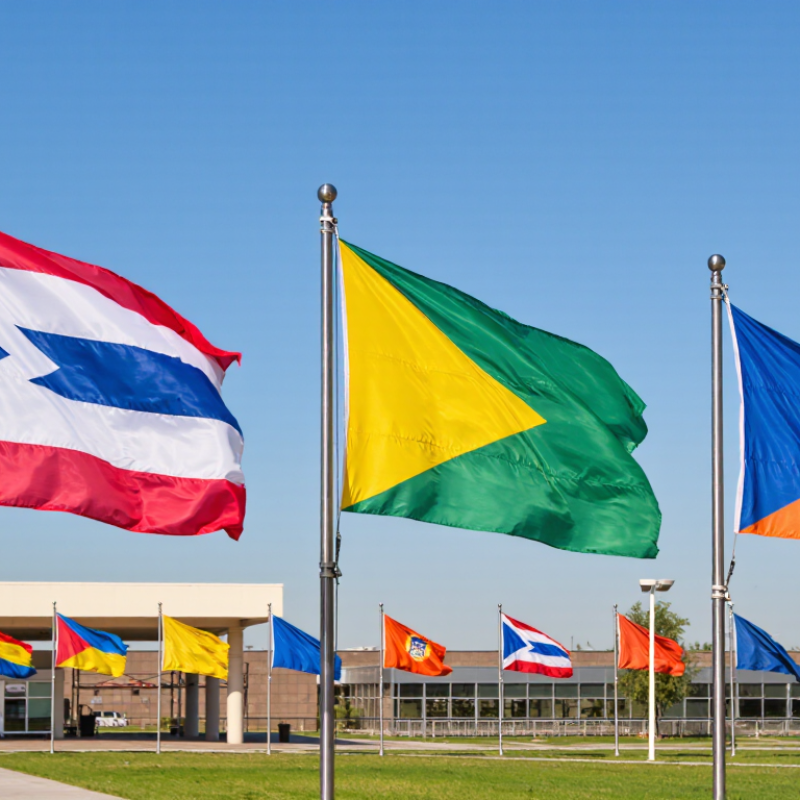
Outdoor flags are printed fabric displays designed for open-air use. They may stand beside shops, exhibitions, sports grounds, hotels, and temporary events. Common formats include feather, teardrop, rectangular, and banner flags. A flexible pole lifts the fabric, while a weighted base keeps it stable.
In 2026, global buyers need outdoor flags because physical visibility still matters in busy streets and event spaces. A clear flag can guide visitors from a car park to an entrance within seconds. It can also present opening hours, service details, or campaign messages without electricity. For buyers serving different climates, material selection is important. UV-resistant fabric helps reduce fading, while reinforced hems and strong stitching support repeated outdoor use. Water-filled bases may suit smooth pavements, but ground spikes work better on soil. Small details matter.
My sourcing experience suggests that sample testing should happen before large orders. I check pole joints, print sharpness, base balance, and packing damage. Specifications can look excellent on paper. Real wind exposes weak points. Buyers should also confirm dimensions, replacement parts, care instructions, and consistent color control across shipments. No product is perfect. A flag may still wrinkle after rain, and a heavy base may increase freight costs. That trade-off deserves honest calculation, not optimistic promises.
Outdoor flags work best when their shape matches the display objective. Feather flags create strong movement and guide visitors toward entrances. Their curved profile remains readable from several angles, even in busy retail areas. Teardrop flags offer a cleaner silhouette and perform well beside roads, sidewalks, and temporary exhibits. They usually need less space than wider banner systems. For direct messaging, rectangular flags provide the largest printable area. They suit event schedules, service details, and directional information.
Wind conditions should influence every purchase decision. Flexible fiberglass poles can reduce stress during moderate gusts, but no flag system is weather-proof. In exposed locations, a heavier cross base, water bag, or ground spike improves stability. Check the fabric density, stitching quality, and UV resistance. A lightweight polyester flag dries quickly, while denser fabric often gives sharper color and longer service life. Field checks matter.
Not every popular format fits every site. I have seen tall feather flags placed under low awnings, where their movement became restricted. That choice looked impressive online but performed poorly in practice. Small pennant strings add energy to festivals and cafés, yet they cannot replace a readable information flag. For repeated international use, choose replaceable graphic panels and hardware with common dimensions. This reduces shipping complications and makes maintenance more realistic. Test one unit before ordering in volume.
When comparing outdoor flags for global markets, start with the environment, not appearance. Polyester usually offers strong outdoor durability and clear color reproduction. Nylon feels lighter and flies well in gentle wind. However, it may wear faster under harsh sunlight and repeated storms. Fabric weight matters, but heavier is not automatically better.
Examine the construction closely. Double-stitched hems reduce fraying along exposed edges. Reinforced corners help prevent tearing around grommets and clips. A strong pole sleeve should hold its shape after repeated installation. Check whether the fabric has UV resistance and water-repellent treatment. Ask for test details, not vague claims. I once selected a thick fabric that looked excellent indoors, yet it dried slowly after rain. That mistake changed my comparison method.
Tips: Request physical samples in several sizes. Bend the hem and inspect loose threads. Compare color under daylight, not only warehouse lighting. Ask how many wash cycles the print can tolerate. Check packaging before ordering globally, because crushed sleeves can arrive with permanent creases. Consider local wind conditions, mounting hardware, and replacement costs. A cheaper flag may need earlier replacement. A premium fabric may still fail if the stitching is weak. Leave room for doubt, especially when supplier data lacks independent verification.
| Material / Construction | Typical Weight | Outdoor Durability | Wind Performance | Color and Print Quality | Recommended Use | Buyer Considerations |
|---|---|---|---|---|---|---|
| Knitted Polyester Single-layer, hemmed edges | Approximately 110–150 g/m² | Good resistance to moisture and abrasion; suitable for regular outdoor exposure | Good air permeability; reduces some wind load compared with tightly woven fabrics | Bright appearance; graphics can be visible through the reverse side with mirror-image printing | General-purpose advertising, events, schools, retail locations, and flagpoles | A balanced option for cost, movement, drying speed, and visual impact |
| Woven Polyester Tightly woven, reinforced hem | Approximately 120–160 g/m² | Very good strength and dimensional stability; handles frequent use well | Better tear resistance than lightweight knitted fabric, but may impose higher pole loads | Smooth surface supports sharp text, logos, and detailed images | Longer-term displays, civic locations, commercial entrances, and institutional use | Check seam quality and pole rating because heavier fabric can increase hardware stress |
| Recycled Polyester Post-consumer or post-industrial fibers | Approximately 100–160 g/m² | Comparable to conventional polyester when properly finished and sewn | Depends on fabric density, yarn quality, and reinforcement method | Good print performance; color results depend on fabric whiteness and ink system | Projects with recycled-content requirements or environmental procurement policies | Request documented recycled content and verify color consistency between production batches |
| Nylon Lightweight woven fabric | Approximately 70–100 g/m² | Light and quick-drying; may show faster wear under intense ultraviolet exposure | Excellent movement in light to moderate wind; not ideal for severe exposure without suitable sizing | Strong color brilliance and attractive fluttering effect | Short-term promotions, ceremonies, indoor-outdoor events, and decorative applications | Prioritize UV-resistant finishing and inspect the leading edge regularly |
| Polyester Mesh Perforated, open structure | Approximately 90–140 g/m² | Good for exposed locations because open construction allows faster drainage and drying | Lower wind resistance and reduced sail effect; useful where wind exposure is a concern | Graphics may appear less solid or less detailed than on dense fabric | Coastal areas, high-wind sites, construction zones, and large-format displays | Confirm viewing distance, mesh openness, and artwork adaptation before production |
| Double-Stitched Construction Folded hem with two or more stitch rows | Adds limited weight; varies by fabric and hem width | Improves edge durability and reduces fraying during repeated use | Better resistance at stress points, especially along the hoist and fly edges | Does not materially change print quality; supports a cleaner long-term appearance | Permanent installations and flags that will be raised and lowered frequently | Ask for stitch spacing, thread type, folded-hem width, and corner reinforcement details |
| Heavy-Duty Reinforcement Webbing, corner patches, and sleeve reinforcement | Varies by reinforcement materials and flag size | Best suited to demanding, long-term installations and repeated windy conditions | Significantly strengthens attachment points and helps distribute pulling forces | No direct effect on artwork; reinforcement may be visible at edges or corners | Large flags, exposed flagpoles, roadside displays, and industrial sites | Match reinforcement to pole hardware, flag dimensions, wind conditions, and local safety rules |
| Dye-Sublimation Printing Dye bonded into polyester fibers | Determined mainly by the selected base fabric | Good wash resistance and reduced surface cracking because the image is not a thick surface layer | Performance depends on fabric and sewing construction rather than the print process alone | Suitable for gradients, photographic images, and full-color designs | Detailed promotional flags and designs requiring broad color coverage | Confirm UV-resistant inks, color proofing standards, and whether reverse-side readability is required |
Outdoor flags face wind, sunlight, rain, and repeated handling. Their design choices directly affect service life.
The World Meteorological Organization reported that 2023 was about 1.45°C above the pre-industrial average. Warmer conditions can intensify outdoor exposure, although local weather remains more important. A tall, narrow teardrop flag often turns smoothly in moderate wind. A rectangular flag provides more visible area but catches stronger loads. This difference matters near buildings, roads, and open fields.
Size should match the pole, base, and installation surface. Oversized fabric on a light base may tip or twist. That mistake is common. Outdoor testing should examine seam strength, hem wear, and pole stress, not only color. ASTM D5034 can help evaluate textile breaking strength, while ISO 105-B02 provides a recognized method for artificial lightfastness testing. These standards do not guarantee a fixed outdoor lifespan. They create useful comparison points.
Sublimation printing gives detailed graphics and supports full-fabric coverage. Screen printing can suit simpler artwork and controlled color areas. UV-resistant inks are essential, but ink alone cannot prevent fabric degradation. The Global Outdoor Advertising Market report by Grand View Research valued the sector at approximately USD 38.54 billion in 2022, reflecting strong demand for visible outdoor communication. Performance still depends on fabric weight, stitch density, curing quality, and maintenance.
Dark colors may absorb more heat. Pale colors can lose contrast under bright sunlight. A practical specification should include expected wind exposure, display hours, washing requirements, and replacement access. There is no perfect universal flag. Field testing remains necessary.
Global buyers should judge outdoor flag suppliers beyond the lowest quotation. A practical review checks fabric density, stitching, pole flexibility, printing quality, and packing strength. Ask for a physical sample, not only digital images. A bright screen can hide uneven edges. Supplier reliability also matters. Request production photos, inspection records, export references, and a clear replacement policy. Smithers’ 2024 industry analysis shows continued growth in digitally printed products, but quality still depends heavily on material control and finishing skills.
Build the landed cost carefully. Include fabric, poles, bases, artwork preparation, packaging, inspection, freight, insurance, duties, and local delivery.
Delivery terms must be written clearly. EXW may leave transport risks with the buyer, while DAP usually gives better cost visibility. UNCTAD reports that ships carry over 80% of global merchandise trade, so port congestion can affect even small flag orders.
My sourcing reviews often find that suppliers estimate production time, but ignore customs clearance. That is a costly gap. A sample may pass inspection, yet bulk colors can vary.
Tips:
Compare three quotations using the same specifications. Confirm fabric weight, flag size, pole length, carton dimensions, and spare parts. Ask for a pre-shipment inspection before final payment. Keep a small buffer for seasonal delays. The cheapest offer is rarely the cheapest delivered. Also, do not assume a polished catalog proves factory capability. A second audit is sometimes worth the expense.
