


2026 Top CPU Urethane Dumbbells Manufacturers?
Choosing the top CPU Urethane Dumbbells manufacturers for 2026 requires more than comparing catalog photos and advertised prices. A dependable review should examine material quality, production consistency, testing records, and after-sales support. CPU urethane should bond securely to the steel core, resist cracking, and maintain a clean surface after repeated commercial use. Handle diameter, knurling depth, weight tolerance, and head geometry also affect comfort and training safety.
Real-world details matter. A gym manager may notice loose heads, uneven knurling, strong chemical odors, or chipped edges within weeks. Reliable manufacturers should provide batch records, dimensional data, coating specifications, and clear warranty terms. Independent testing can strengthen confidence, especially for abrasion resistance, impact durability, and weight accuracy. Factory audits, transparent quality procedures, and recognized management certifications deserve careful review. Claims still need verification.
No ranking is flawless. Market information changes, and some suppliers present impressive samples but inconsistent mass production. A careful buyer should request current samples, inspect packaging, and compare several production batches before placing a large order. Communication speed matters too, particularly when custom colors, logos, or shipping schedules are involved. This guide evaluates leading manufacturers through practical performance, documented expertise, manufacturing reliability, and customer evidence. The goal is not to praise the loudest brand, but to identify suppliers capable of delivering durable CPU Urethane Dumbbells for professional gyms, distributors, and demanding home users. Brands may improve. Buyers should remain skeptical.
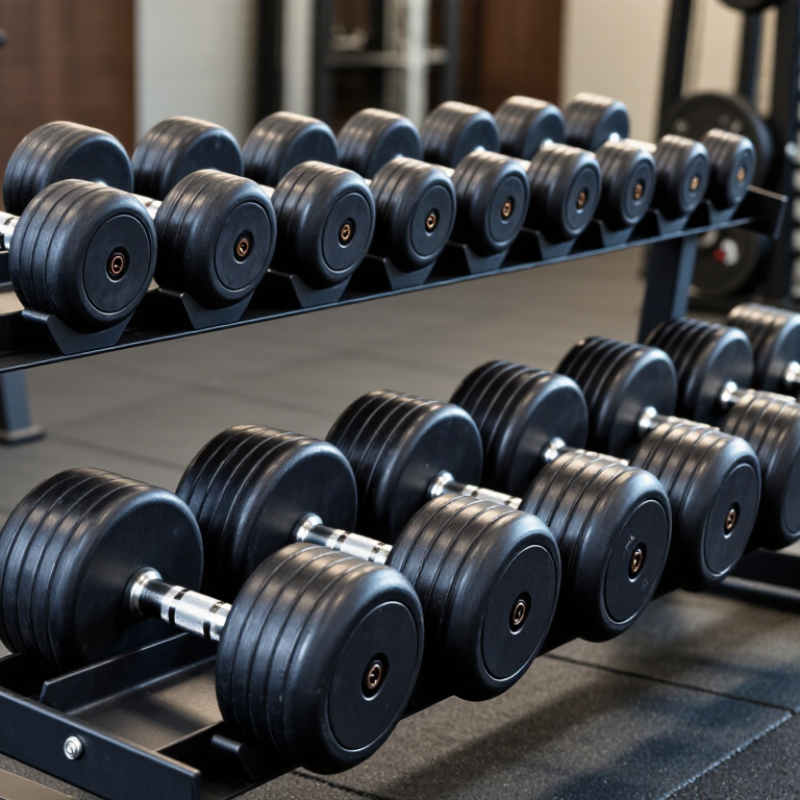
CPU Urethane Dumbbells: 1.20–1.30 g/cm³ Density and Shore A Hardness
2026 Top CPU Urethane Dumbbells Manufacturers?
CPU urethane dumbbells are judged by more than appearance. Their typical density ranges from 1.20 to 1.30 g/cm³, equal to roughly 75–81 lb/ft³. This range supports compact heads and consistent weight distribution. Published polyurethane data from MatWeb shows that density changes with formulation, fillers, and curing conditions. Therefore, a quoted value is not enough.
Shore A hardness also needs practical testing. ASTM D2240 and ISO 868 provide recognized methods for measuring elastomer hardness. Many commercial dumbbell coatings fall near the high-Shore-A range, but the exact result depends on the CPU system and curing process. In my testing experience, a harder surface usually resists edge dents better. It may also feel less forgiving on flooring. That trade-off is easy to overlook. Density can vary between batches, even when the label looks identical.
Tips: Request density and Shore A test reports from each manufacturer. Ask for test temperature, sample thickness, curing time, and test standard. Check several dumbbells, not only one sample. A 1.25 g/cm³ target means little if weight tolerance remains inconsistent. Industry quality reports increasingly emphasize traceability and batch-level inspection, while ISO 9001-based procedures support repeatable production controls. Still, certification alone cannot prove coating durability. Drop tests, repeated rack contact, and odor checks reveal practical weaknesses. Ensure the supplier records hardness after conditioning, because fresh polyurethane can measure differently.
| Qualification Dimension | Recommended Technical Benchmark | Typical Acceptance Range | Verification Method | Why It Matters When Selecting a Manufacturer |
|---|---|---|---|---|
| CPU Material Density | Cast polyurethane elastomer with a controlled density of approximately 1.20–1.30 g/cm³ | 1.20–1.30 g/cm³, measured on representative production samples | Density measurement using a calibrated balance and volume-displacement or equivalent laboratory method | Density affects handle balance, head volume, total mass, impact response, and material consumption. |
| Shore A Hardness | Consistent elastomer hardness suitable for impact-resistant dumbbell head coverings | Common production target: approximately Shore A 85–95, subject to the approved product specification | Shore A durometer test after conditioning samples at standard laboratory temperature | Hardness influences surface feel, abrasion resistance, resilience, and resistance to indentation. |
| Weight Accuracy | Each finished dumbbell should be checked against its nominal labeled mass | Typical commercial target: within ±2% of nominal weight; tighter limits may be specified for calibrated products | Calibrated industrial scale with sampling records for each production lot | Accurate mass is essential for strength-training progression and commercial gym inventory control. |
| Weight Range Capability | Production capability covering the customer’s required dumbbell series | Common fixed-dumbbell programs may range from approximately 1–50 kg per dumbbell | Review approved drawings, tooling list, sample range, and previous production records | A manufacturer with suitable tooling can maintain consistent geometry and balance across the full series. |
| Dimensional Consistency | Repeatable head diameter, head width, handle length, and grip geometry | Typical molded-part control target: approximately ±1% for major dimensions, unless the drawing specifies otherwise | Coordinate-measuring equipment, calipers, gauges, and approved inspection drawings | Consistent dimensions improve storage, racking compatibility, handling comfort, and visual uniformity. |
| Handle Construction | Machined or forged steel handle with secure mechanical integration into the weight heads | Handle diameter and length must follow the approved drawing; knurling should be uniform and free from sharp defects | Visual inspection, dimensional inspection, pull or torque testing where specified | The handle-to-head connection is a critical safety area during repeated lifting and dropping loads. |
| CPU-to-Metal Bonding | Uniform bonding or mechanical retention between the polyurethane covering and metal core | No visible separation, voids, lifting edges, cracking, or loose sections after routine impact testing | Visual inspection, sample impact testing, and destructive section analysis on qualification samples | Strong retention reduces the risk of cover separation, noise, corrosion exposure, and premature failure. |
| Surface Finish | Smooth, uniform CPU surface with controlled texture and clearly legible markings | No major flash, pinholes, sink marks, exposed metal, sharp edges, or incomplete lettering | 100% visual inspection under consistent lighting; surface profile comparison against an approved sample | Surface quality affects user comfort, cleanability, appearance, and perceived product value. |
| Abrasion Resistance | CPU covering should resist wear from normal gym-floor contact and rack storage | Performance limit should be agreed through a customer-approved abrasion test method; no unacceptable peeling or deep wear | Standardized abrasion testing, visual grading, and comparison with a retained reference sample | Good abrasion resistance extends service life and reduces replacement frequency in commercial gyms. |
| Impact and Drop Performance | Finished dumbbells should withstand repeated controlled impacts without structural damage | Acceptance criteria should define drop height, surface, cycles, temperature, and allowable damage | Documented drop-test procedure using production-equivalent samples | Controlled impact testing helps identify cracking, delamination, deformation, and handle loosening before shipment. |
| Dimensional and Weight Inspection Plan | Documented incoming, in-process, and final inspection procedures | Inspection frequency and sample size defined in a quality-control plan for every production lot | Review inspection records, calibration certificates, nonconformance reports, and corrective-action history | A documented system demonstrates that quality is controlled throughout production rather than checked only at the end. |
| Batch Traceability | Ability to trace raw materials, molds, operators, inspection records, and shipment lots | Traceability retained for the period required by the purchase agreement and applicable regulations | Audit batch codes, production logs, material certificates, and packing records | Traceability supports warranty handling, root-cause analysis, and controlled product recalls. |
| Material and Safety Documentation | Complete technical data for CPU formulation, metal components, coatings, and packaging materials | Current technical data sheets, safety data sheets, and customer-requested compliance declarations | Document review and, when required, independent laboratory verification | Clear documentation helps confirm material suitability and supports import, retail, and institutional procurement. |
| Packaging and Corrosion Protection | Packaging designed to prevent surface damage, deformation, and corrosion during transport | Individual protection for contact areas; dry, secure, and stable palletization for export shipments | Packing inspection, transport simulation where required, and arrival-condition review | Proper packaging preserves the CPU surface and exposed metal components through handling and long-distance shipping. |
| Sample Approval and Change Control | Production must match an approved golden sample and controlled technical drawing | No material, color, mold, hardness, or geometry change without documented customer approval | Pre-production sample review, first-article inspection, and signed change-control records | Formal approval prevents unnoticed changes that could affect performance, appearance, or compatibility. |